
Body Lift Surgery
in Dallas, TX
What Is a Body Lift?
“Belt lipectomy,” “body lift,” “lower body lift,” and “360 body lift” are terms used interchangeably for body lift surgery in Dallas, TX. They describe a surgical procedure that removes sagging skin and excess fat from the lower abdomen, flanks, buttocks, and surrounding lower body to improve contour, especially after massive weight loss. It is ideal for those who are mildly overweight with excess tissue, or for patients at a healthy weight who want more reshaping than a tummy tuck can provide.
Read on to learn what the procedure involves, who makes a good candidate, the results and benefits patients can expect, how surgery and recovery typically unfold, and the key risks and patient perspectives that matter when considering treatment in Dallas.
Model
Table of Contents
- Body Lift Before and After Photos
- Real Stories: Patient Reviews
- What Does a Full Body Lift Include?
- What Can a Lower Body Lift Treat?
- Who Are Candidates for Belt Lipectomy Surgery in Dallas?
- What Does a Body Lift Accomplish?
- How Is Body Lift Surgery Performed?
- What Is Dr. Aly’s Experience With Body Lift Surgery?
- Can You Combine a Body Lift With Other Surgeries?
- Body Lift Procedure Timeline
- What Is Body Lift Recovery Like?
- When Can I Expect the Final Results of Body Lift Surgery?
Body Lift Before and After Photos
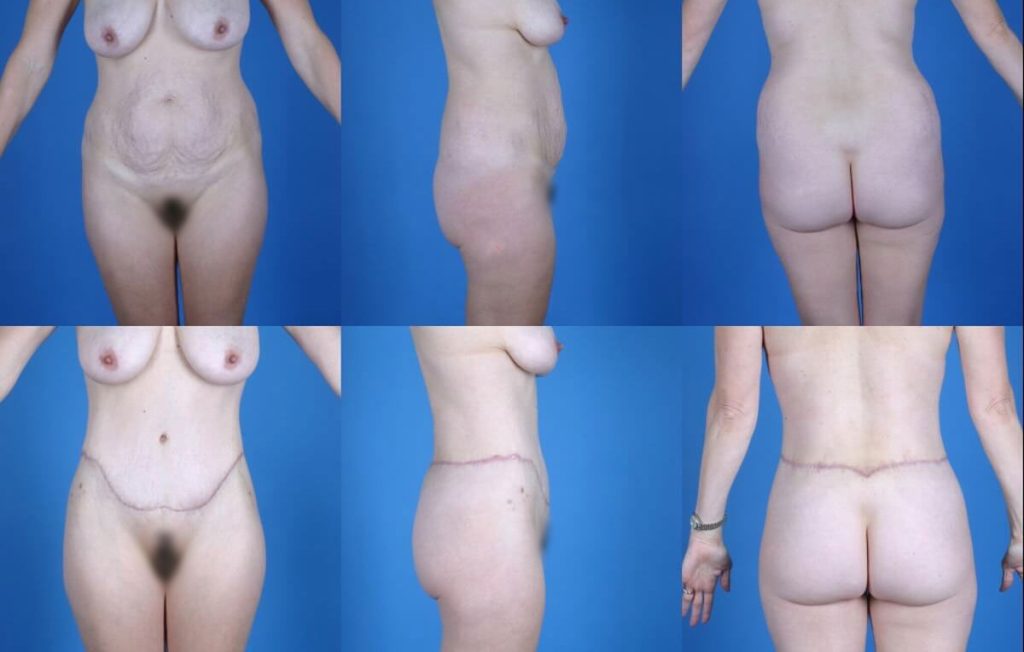
Body Lift Before and After Gallery
Real Stories: Patient Reviews

“Dr. Aly is extremely knowledgeable, patient and thorough. We knew exactly what to expect throughout the entire process. The surgery and recovery both went smoothly. Hard to explain, but he did things differently in a good way! One of the best, if not THE BEST in America!” —G. H.
“Integrity, compassion, humility, creativity, ingenuity and commitment to excellence, was present throughout my entire experience with Dr. Aly. Given that, and his incredible skill as a plastic surgeon, I would not hesitate to recommend Dr. Aly. He is absolutely amazing!” —F. D.

What Does a Full Body Lift Include?
Body lift surgery addresses the areas from just underneath the chest or breast, spanning down to the pubic area, flanks, and buttocks, with benefits to the hips and thighs as well.
What Can a Lower Body Lift Treat?
- A protruding belly in the lower abdomen and upper abdomen, including above the navel
- A hanging belly apron (called a panniculus)
- A droopy pubic area
- 360-degree excess skin and fat of the lower torso, including the belly, flanks, buttocks, hips, and outer thighs
- Droopy thighs
- Lack of shape and/or waist definition
- Droopy buttocks
Who Are Candidates for Belt Lipectomy Surgery in Dallas, Texas, the entire US, and Around the World?
Massive Weight Loss Patients (After Bariatric Surgery and/or GLP Use and/or Diet and Exercise)
The most common body lift/belt lipectomy candidates are patients who have lost a massive amount of weight. The majority of these patients started out as obese and lost weight through bariatric surgery, GLP use, and a smaller subset lost weight through diet and exercise alone. Today, many patients will present after a combination of the above methods is utilized. Body lift/belt lipectomy surgery is also pursued in aging patients who have loose skin.
Good candidates are healthy, are at a stable weight, are non-smokers, and have realistic expectations.
Mildly Overweight Patients With 360-Degree Excess Tissue
Less frequently, a belt lipectomy/360 body lift is utilized on patients who are mildly overweight and present with excess tissue around their midsection, including on their abdomen, flanks, and buttocks.
Patients of Average Weight Who Want More Improvement Than a Tummy Tuck
A third group of body lift candidates is at a healthy weight but wants more than the usual correction attained by a tummy tuck (abdominoplasty). A tummy tuck’s effects are limited to the belly. Patients in this weight group desire a remarkable improvement in the definition of their waist, thighs, and buttocks.
In General the Best Possible Contour
The best possible contour of the lower trunk, which begins just below the breasts/chest and spans down to the pelvis, can be achieved by a well-performed belt lipectomy. It is far superior to what can be attained by a tummy tuck, with or without liposuction.
Ideal Body Lift Candidates Should:
- Be mentally stable
- Be non-smokers
- Have maintained a stable weight for at least three months, preferably longer (weight must be stable to consider surgery; patients should not be gaining or losing weight)
- Have lost enough weight to allow the surgeon to flatten out the belly (fat around internal organs, if excessive enough, can prevent abdomen from being flattened surgically, and this fat cannot be surgically removed, only reduced through weight loss)
- Not be significantly obese
- Have no active medical problems such as diabetes, uncontrolled high blood pressure, heart disease, etc.
Can I Get a Lower Body Lift With a High BMI?
Belt lipectomy results, like all other aspects of massive weight loss body contouring, tend to be better if you are at a lower weight. Dr. Aly has also found that the lower the BMI of the patient, the less likely they are to experience a complication.
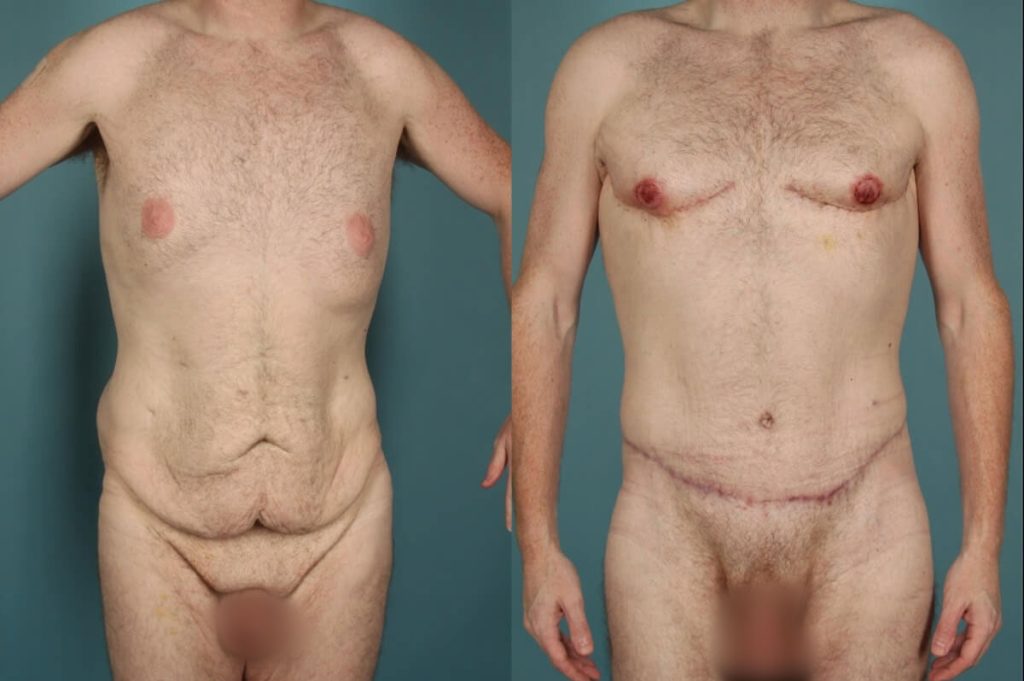
Our gallery of before and after body lift photos includes a range of patients who started at high BMIs and reached varying weight levels prior to surgery.
If you look at patients who present at a BMI above 35, you will notice that they attain decent improvements, but their results are not as remarkable as those of patients who present in the 30–35 BMI range. And if you compare those who present at a BMI of 27 and below, their improvements are more remarkable than those in the higher BMI range of patients, sometimes leading to almost ideal body contours.
Because of the tendency for better results and fewer complications, since the advent of GLPs, most patients in the higher BMI ranges are encouraged to drop down to lower levels.
What Does a Body Lift Accomplish?
A body lift has multiple benefits, which include:
- Eliminating hanging belly skin and fat
- Creating a flat belly
- Lifting the pubic area
- Lifting the front and sides of the thighs
- Eliminating flank excess skin and fat
- Creating a more defined waist, especially in females
- Lifting the buttocks
How Is Body Lift Surgery Performed?
The Mannequin and Dress Analogy
One can think of excessive skin and fat as a loose dress on a mannequin, and the mannequin is the underlying muscles and bones. A body lift can be compared to cutting out parts of the loose dress to better fit the underlying muscles and bones.
It is important to understand that the mannequin has a cavity inside it, deep beneath the muscles, which contains all of the internal organs, such as the intestines, kidneys, liver, etc., that all lie in fat. The outer cover of this cavity is the “six-pack muscles” connected to a set of muscles that go all the way around the body. This internal cavity can be thought of as an internal balloon that is often loosened by the overgrowth of fat or during pregnancy.

Once weight loss takes place, the internal balloon becomes loose, leading to bulging of the belly. This is manifested by a separation between the “six-pack muscles.” To flatten out the belly, those muscle edges must be brought back together.

This figure shows the separation between the muscles and how it is eliminated surgically.
It is important to note that different patients present with different problems. What is described here is the typical procedure, but there are variations.
An animation of what occurs with a body lift is shown here. It is helpful in conceptually understanding what is to be accomplished with this type of surgery.
A belt lipectomy is performed on people with circumferential (360-degree) excess skin and fat. In lower body lifts, a circumferential incision is used, and the body lift performed typically takes about three to six hours. A circumferential wedge of skin and fat is removed in the shape of a boxing championship belt, wider in the front and narrower in the back.

This means the patient must be turned once or twice during the procedure to allow the surgeon to remove all of the necessary tissue.
After the patient is anesthetized, Dr. Aly prefers to begin operating on the front side in the majority of cases. This is done in a similar, but not identical, fashion to a tummy tuck.
How will Dr. Aly address the front of my body?
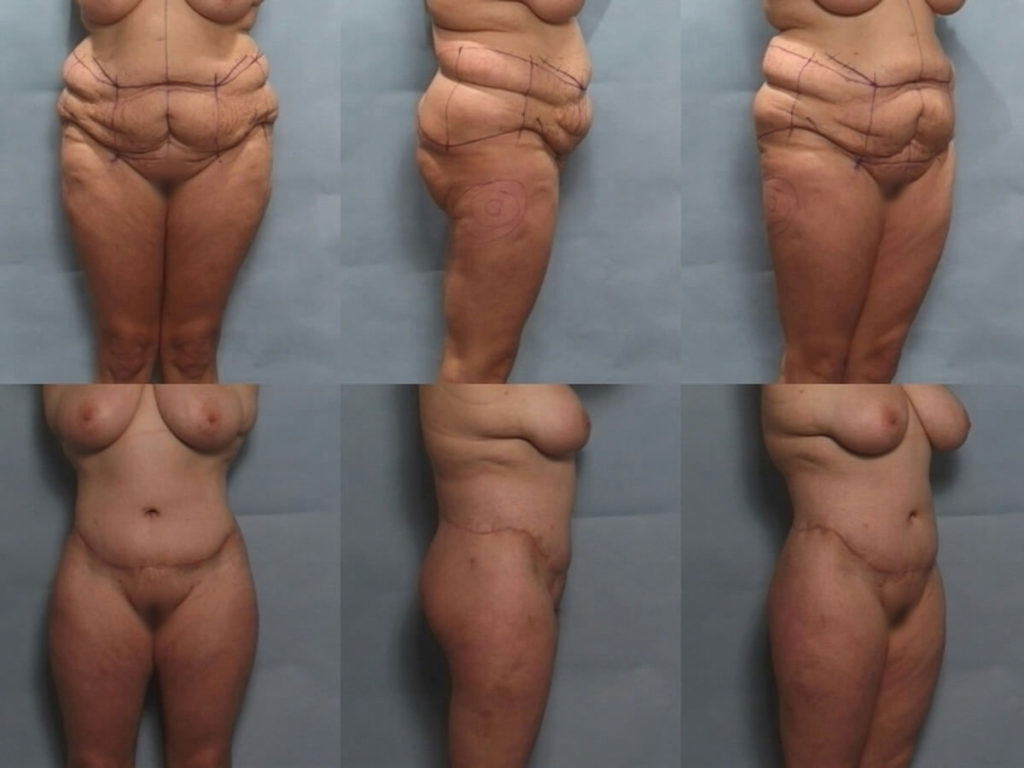
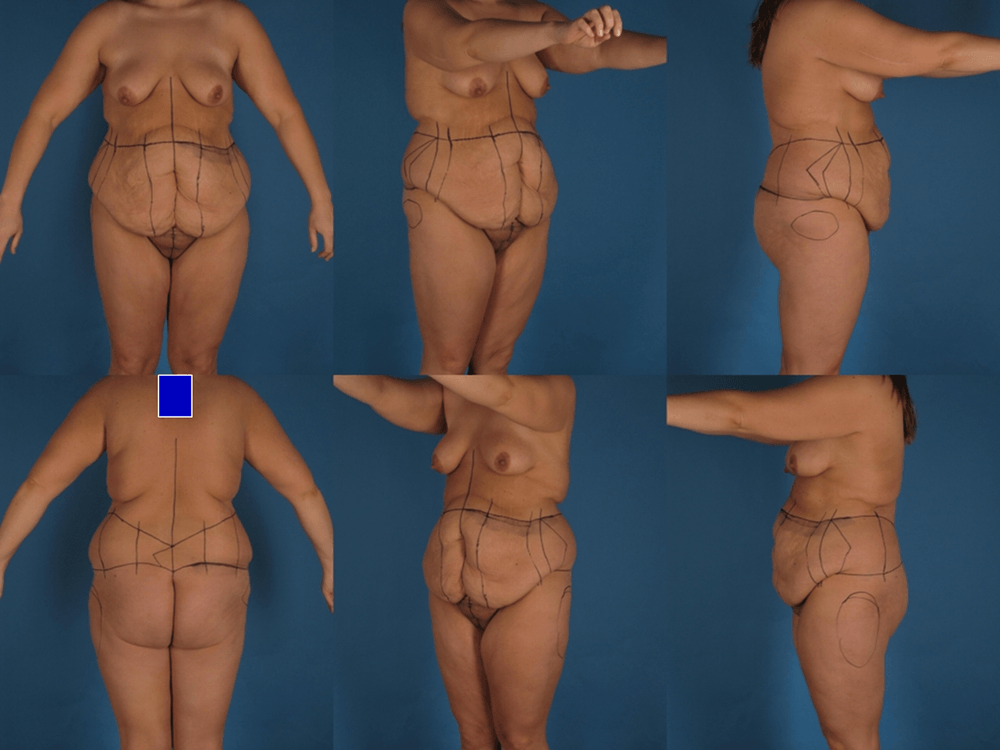
Prior to surgery, Dr. Aly marks both the front and back to delineate the excess skin and underlying fat to be removed. These are the typical markings that are placed by Dr. Aly one to two days prior to surgery. Note that both skin and fat are removed from the top line to the bottom line from the front, sides, and back.
Note how, in one, you can see the underlying muscles and bones (which can be thought of as the mannequin marked by the yellow dotted line) through the skin/fat envelope (the overlying dress) before surgery and how a body lift/belt lipectomy exposes the mannequin after surgery. This is a manifestation of The Mannequin and Dress Analogy, shown above.


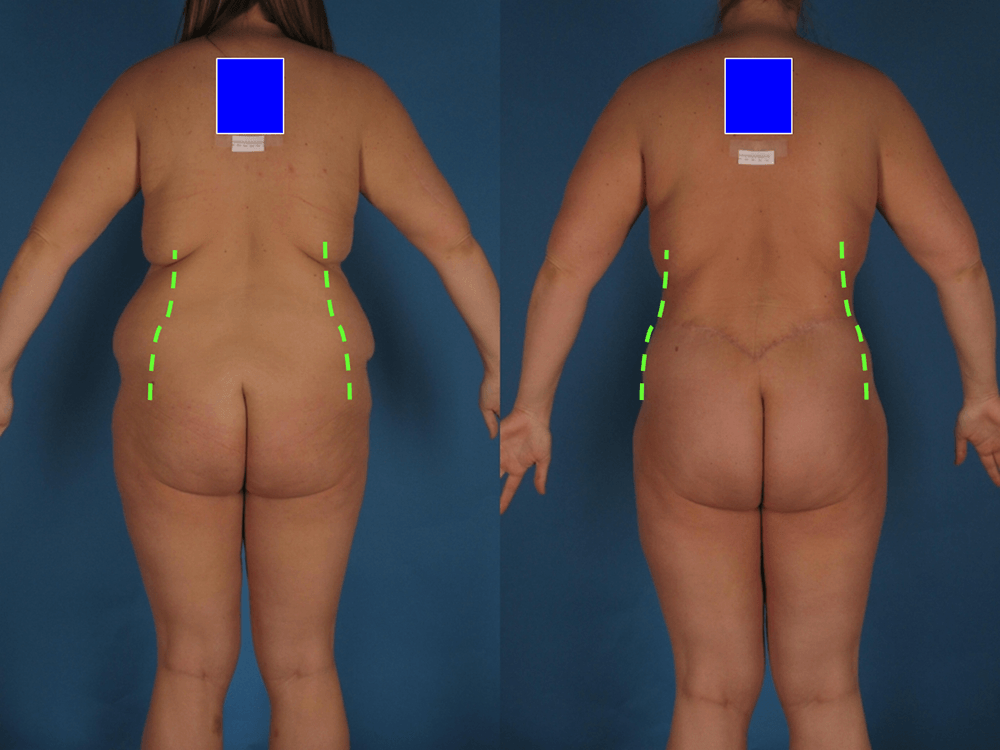
During surgery, Dr. Aly cuts around the natural belly button and leaves it in place. Subsequently, the skin and fat of the belly are lifted from the pubic area to the rib cage, similar to lifting a sheet off of a bed. At this point, the six-pack muscles of the belly, or abdominal muscles, are exposed and are brought together to flatten out the inner balloon.
The skin and fat that were lifted up to the rib cage are then stretched down, similar to pulling a wrinkled bed sheet over the bottom edge of the bed, and the excess is eliminated. Then, a new belly button is created.
How will Dr. Aly address the sides and back of my body?
Next, the patient is turned on their belly, and the excess tissue from the sides to the middle of the back is removed.
The patient is then placed on their back on their hospital bed, and a light compression garment is applied with foam underneath it. This sequence is the most common method utilized by Dr. Aly.
In some patients, the sequence of body positions may be different; this depends on each patient’s particular anatomy at presentation.
Is a body lift for men performed differently?
In male patients, the sequence is usually identical, but because of variance in the natural fat deposition pattern and body shape, adjustments are made to accommodate those differences.
Will body lift surgery help me lose a significant amount of weight?
Body contouring surgery after massive weight loss should not be thought of as a way to lose weight. Although a large amount of tissue is removed that may be considerable in weight, the actual change in weight after you have healed and stabilized is often less than you would think.
Body contouring after weight loss, and belt lipectomy in particular, should be thought of as surgery that alters body contour rather than weight loss surgery.

What Is Dr. Aly’s Experience With Body Lift Surgery?
Dr. Al Aly is a board-certified plastic surgeon who has been performing belt lipectomy surgery for over 28 years. He published the first major scientific article on belt lipectomy treatment in the massive weight loss population and the first textbook on massive weight loss body contouring, which extensively covers belt lipectomy, among other body contouring procedures, such as brachioplasty, upper body lifts, and thigh reduction surgery.
Dr. Aly is recognized worldwide as the pioneering plastic surgeon of this type of surgery. He received the prestigious Lockwood Award in 2008 from the Aesthetic Society (formerly the American Society for Aesthetic Plastic Surgery) for his contributions to the field of body contouring.
Can You Combine a Body Lift With Other Surgeries?
Although some surgeons may combine a body lift with procedures such as liposuction or tummy tucks, using multiple surgical techniques in one operation, Dr. Aly prefers not to, with very few exceptions, for the following reasons:
- Prolonging surgery increases the risk of complications to an unacceptable level. This is elective surgery, and Dr. Aly feels that it is prudent to minimize the risks as much as possible.
- It’s best to control scar position as much as possible. For example, if you combine your lower body lift with an upper body lift, the tissues are pulled in opposing directions, which will prevent your plastic surgeon from being able to control scar position.
Body Lift Procedure Timeline
What should I expect before belt lipectomy surgery?
During your initial visit with Dr. Aly, he will perform a complete history and physical. He will determine if you need to see any other physicians to “tune you up” prior to surgery. You will have a set of photographs taken, which will allow Dr. Aly to make the correct diagnoses and plan for the upcoming surgery/surgeries.
Over one to two visits, Dr. Aly will discuss the potential surgical procedures you may require and show you before and after pictures of patients who have undergone similar procedures. During the initial consultation, his assistant will discuss the expected cost for your cosmetic surgery plan. Body lift surgery costs vary based on the techniques used, and body lift procedures are not covered by insurance. Surgical, anesthesia, and facility fees also contribute to the total price.
Dr. Aly will have a discussion with you about the potential benefits and risks associated with a belt lipectomy. A set of lab tests is performed to determine if you have any abnormalities that need to be adjusted prior to surgery. It’s also standard for patients who plan to undergo a body lift to be psychiatrically cleared for surgery.
Many patients will require multiple operations to eliminate all of their excess skin after massive weight loss. Dr. Aly will sit down with you to create a course of action to accomplish your aesthetic goals. You will have markings placed on your body one to two days before your operation in preparation for surgery.
What happens on the day of my body lift surgery?
On the day of surgery, you will be admitted to the surgery center and prepared for surgery. You will meet the anesthesiologist, and they will discuss your anesthesia plan. Dr. Aly will come in to say hello and make sure the markings that were made are still in place and, if need be, adjust them.
You will then be taken to the operating room, and the anesthesiologist will put you under a general anesthetic. Surgery is then performed. Timing varies depending on your particular anatomy, but a lower body lift typically takes four to six hours.
No Drain Surgery
Dr. Aly does not use drains with any of his surgical procedures, including belt lipectomy. This is fairly unusual but has served his patients very well. Drains are utilized to eliminate or decrease seromas, fluid collections that can collect in the areas of surgery. Instead of drains, Dr. Aly utilizes “internal quilting sutures”, which close dead space in the areas operated on, greatly decreasing the risk of seromas far more effectively than when drains are used.
Other benefits of not using drains include:
- Decreased discomfort from the drains
- Decreased care required by the drains
- Potentially less risk for infections and accidental drain removals
Probably the most important benefit of not using drains combined with the internal quilting sutures is that Dr. Aly’s seroma rate has dramatically decreased since he stopped using drains.
What happens immediately after surgery?
After surgery is done, a light compression garment will be placed on and around your belly and back with foam underneath it. Dr. Aly does not use postoperative drains, so you will not have to worry about that. You will be admitted overnight.
Patients are expected to get up and walk a few hours after surgery, at least a few steps, after they are awake and alert. This is very important because it reduces the risk of blood clots. The next day after surgery, you will be encouraged to sit in a chair or walk, with as little time as possible spent in bed. Patients are required to go home the day after surgery to reduce the risk of staying in bed and thus reducing the risk of blood clots.

What Is Body Lift Recovery Like?
The First Few Weeks After Surgery:
Patients will usually come back to see Dr. Aly within a few days after discharge for follow-up appointments to monitor healing, check incision sites, and assess their overall well-being. During the first week after surgery, you are expected to walk at least six times a day and stay out of bed as much as possible. You are instructed to remove your compression garment and underlying foam, shower, and reapply the foam and garment daily. Foam is usually discontinued after 7–10 days.
During this first week, you will find that walking slightly bent at the waist will be more comfortable. You may be taught exercises on how to straighten up when you come back after one week from surgery. Once you are able to straighten up, most people find that their recovery becomes much less difficult.
Bruising, swelling, and soreness are expected throughout the first several weeks after the procedure. Initially, patients are most comfortable walking with a slight bend at the waist. After five to seven days, you are encouraged to straighten up slowly, which greatly enhances your level of comfort.
During the first few weeks after surgery, you will usually visit Dr. Aly’s office once a week, unless you live far away and are not experiencing any problems. He will make sure you are doing well and not experiencing any problems such as wound separations or fluid collections, which are called seromas.
No Narcotics After Surgery
Dr. Aly’s practice is both a “No Drain” and “No Narcotic” practice. In order to maximize pain reduction and create as smooth a recovery as possible, patients are injected with a local anesthetic, EXPAREL®, everywhere that is operated on during a body lift/belt lipectomy, which lasts from 48–72 hours. This is an extremely effective mode of pain control that, along with the No Narcotic postoperative regimen, has been the best level of pain reduction in Dr. Aly’s 30 years of practice.
Patients are prescribed a number of medications for pain after surgery, with the main component being Journavx, a medication that is equivalent to a narcotic in pain relief, but without the bad side effects. This is a new, recently FDA-approved pain control medication that provides further significant pain control and carries patients through the toughest time after surgery with very manageable discomfort.
After the First Few Weeks:
Depending on the particular patient’s type of work, some are able to get back to work within a few days if they have a desk job or work from home because Dr. Aly does not utilize narcotics. Most patients are able to get back to their normal life in four to six weeks after surgery, though recovery time varies and light activities are resumed gradually; heavy lifting and intense workouts are usually restricted for six to eight weeks.
You will be seen approximately once a month for three to four months, depending on how you are progressing. You will be seen then at 6 months and then at 12 months.
If you live far away, the time between visits can be extended depending on how you are doing. Occasionally, some patients’ deep sutures will come through the skin, which can be taken care of during these longer-term visits.
Most patients will stabilize their results at the one-year mark, though recovery and maturation can continue for up to a full year, so Dr. Aly prefers to see most patients up to that time. If you are able and willing, he will continue to see you yearly after that.
When Can I Expect the Final Results of Body Lift Surgery?
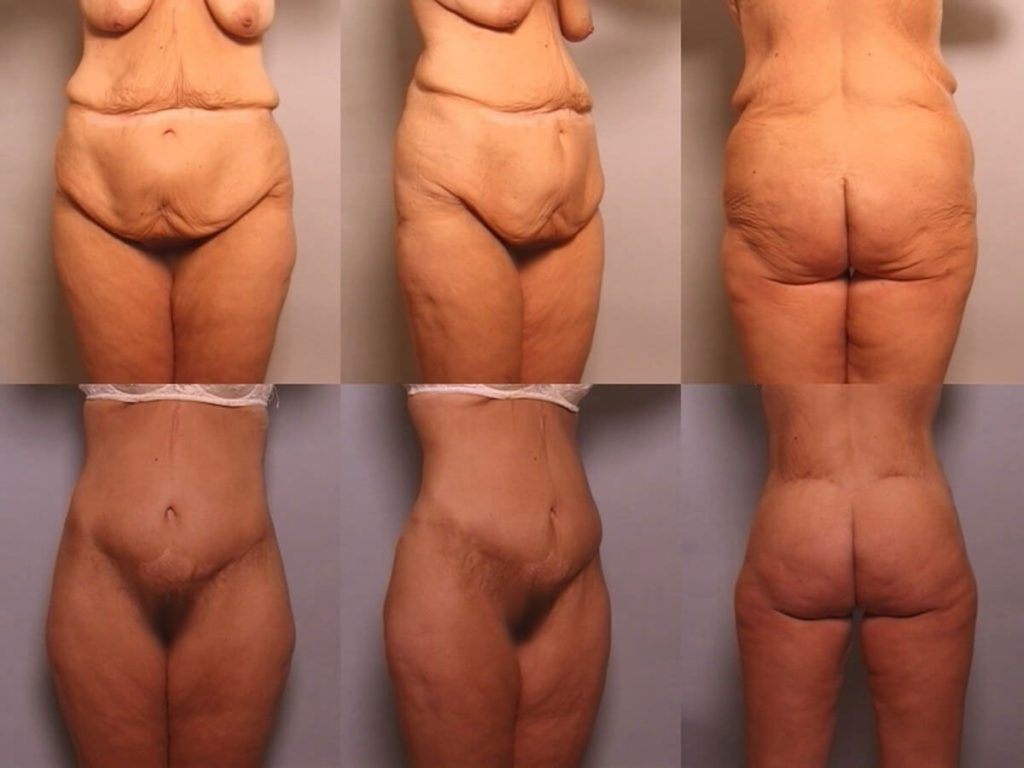
In most patients, there is a dramatic change in the appearance of their body immediately after surgery. However, the contour will not develop to its final result until a full year has passed.
There are significant changes and improvements noted on postoperative photographs when comparing the immediate postoperative period to photographs taken three months after surgery. A personalized treatment plan also affects how swelling resolves and how the contour refines over time. There is another dramatic change that occurs from three to six months. There is still improvement from 6–12 months, but usually not as dramatic as the previous periods.
Scars mature, as far as thickness and width, in 12–18 months, but color will continue to improve for up to 5 years in some patients. Maintaining a healthy lifestyle helps support long-term body lift results.
Have additional questions about body lift surgery?
Contact us to schedule your consultation.